



Key points
- The International Accounting Standards Board (IASB) has published an exposure draft proposing a new accounting model to better reflect how banks manage interest rate risk. The publication of the exposure draft marks a significant milestone in the IASB’s project and is the culmination of extensive discussions and outreach with financial institutions.
- The exposure draft is open for comment until 31 July 2026.
- Banks are encouraged to undertake field testing of the model when submitting comments to the IASB. The final results of such field tests can be submitted to the IASB on a confidential basis by no later than 30 November 2026.
What is the issue?
Banks commonly use interest rate derivatives to dynamically manage their net open risk position – specifically, the interest rate repricing risk arising due to mismatches between interest-bearing assets and funding resources in the banking book.
In contrast, under current hedge accounting models, designations are typically applied to gross exposures (using a bottom layer approach). As a result, the current requirements might not distinguish between accounting for derivatives which have been used solely for risk reduction and other derivatives which introduce new risk.
In addition, these requirements have been observed to result in limited recognition of ineffectiveness and/or recycling of derivative gains and losses, even when significant events occur. For example, relatively insignificant profit or loss volatility has been observed in connection with:
- significant disposals of part of the business;
- significant prepayments on fixed-rate mortgages (for example, amid notable interest rate declines between 2000 and 2020);
- impairments recorded due to the restructuring of Greek government bonds during the European debt crisis; and
- the change from fixed to floating rates resulting from the European Central Bank’s targeted longer-term refinancing operations programme (TLTRO III).
Accordingly, existing hedge accounting requirements might not always meet the information needs of users seeking to understand the results of dynamic, portfolio-level risk management.
To address the limitations with current accounting models, the IASB developed the risk mitigation accounting (‘RMA’) model (previously referred to as the dynamic risk management (DRM) model), which aims to better reflect the economic effects of an entity’s risk management activities related to interest rate repricing risk exposure managed on a net basis.
Which hedge accounting models are currently in use?
Banks, currently, have an accounting policy choice: they can apply either the hedge accounting requirements of IFRS 9, ‘Financial Instruments’, or those of IAS 39, ‘Financial Instruments: Recognition and Measurement’. Regardless of the policy choice applied, banks can continue to apply IAS 39’s requirements for fair value hedges of interest rate risk for portfolios of financial assets or liabilities (commonly referred to as ‘fair value macro hedges’).
Banks applying IFRS Accounting Standards as adopted in the European Union (EU) typically make use of the EU IAS 39 portfolio fair value hedge carve-out, which – unlike IAS 39 as issued by the IASB – permits macro fair value hedging of core demand deposits. In contrast, some banks applying IFRS Accounting Standards as issued by the IASB apply macro cash flow hedge accounting under IAS 39 or IFRS 9, while others apply a combination of macro fair value hedge accounting and macro cash flow hedge accounting under IAS 39.
The ability to continue to apply IAS 39’s requirements is a temporary option until the IASB completes the project. Based on current proposals, once the RMA model is effective, banks applying IAS 39 will be required to discontinue all of their IAS 39 hedging relationships, and they could choose to apply either the general hedge accounting models in IFRS 9 or the RMA model.
As part of its consultation, the IASB is seeking feedback on whether the development of the RMA model justifies the withdrawal of the hedge accounting requirements in IAS 39.
How does the proposed RMA model work?
Like current hedge accounting under IAS 39 and IFRS 9, the application of the RMA model will be optional and will be applied prospectively.
Key elements of the RMA model
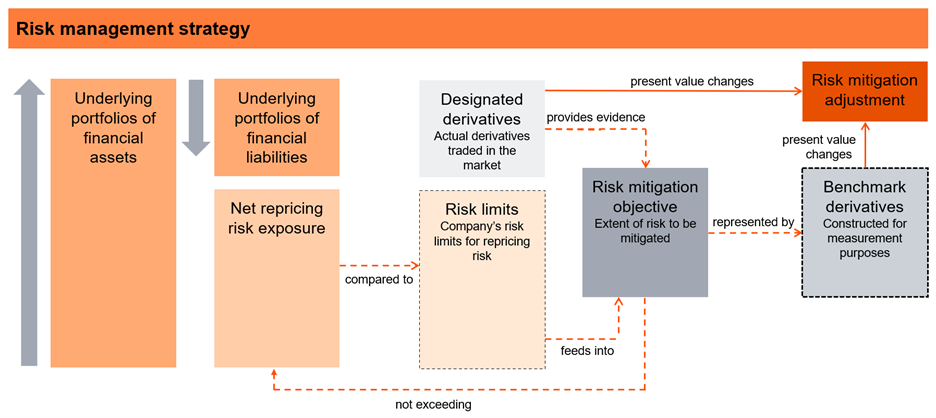
The RMA model is structured to reflect the main activities involved in risk management. The key elements of the RMA model which drive the accounting include the following:
- Risk management strategy: Entities must identify and document risk limits for repricing risk in each repricing time band and specify the mitigated rate(s) – that is, the benchmark interest rate based on which an entity manages repricing risk. The RMA model does not prescribe specific risk management metrics. Entities might aim to stabilise net interest income (earnings perspective) in some time bands, and to protect the fair value of financial assets, liabilities and future transactions (economic value perspective) in others.
- Net repricing risk exposure (previously referred to as the ‘current net open risk position’): The net exposure to repricing risk, prior to risk management activities, arising from an entity’s underlying portfolios for which an entity manages repricing risk on a net basis (for items eligible to be included in the underlying portfolios, see below), determined based on the mitigated rate.
- Risk limit (previously referred to as the ‘target profile’): The thresholds for levels of repricing risk that the entity is willing to accept.
- Risk mitigation objective (previously referred to as the ‘risk mitigation intention’): The absolute amount of repricing risk that the entity intends to mitigate, as set out in its risk management strategy. The actions that an entity has taken to mitigate repricing risk by entering into designated derivatives are the most relevant evidence of the entity’s risk mitigation objective.
- Benchmark derivatives: The risk mitigation objective is represented by benchmark derivatives, which are theoretical derivatives constructed to replicate the timing and amount of repricing risk specified in the risk mitigation objective. These are set to have an initial fair value of zero, based on the mitigated rate.
- Designated derivatives: Interest rate derivatives (linear and non-linear) used to mitigate repricing risk on a net basis (except net written options), unless its fair value changes are dominated by the effect of risks unrelated to changes in the mitigated rate, such as credit risk. Only derivatives with external counterparties are eligible to be designated.
PwC observation
Non-linear derivatives, such as options (except for net written options), are eligible for designation under the RMA model. However, their practical application remains uncertain, since this was not a primary focus during the model’s development. As a result, the use of non-linear derivatives is likely to be a key topic during the consultation period.
Banks might suggest methodologies for the construction of benchmark derivatives when using non-linear derivatives to hedge non-linear risks. If the RMA model caters well to the use of non-linear derivatives, this might prove an attractive aspect of the model for banks anticipating greater use of such derivatives in response to heightened regulatory attention on portfolios subject to non-linear risk.
Fieldwork examining the use of non-linear derivatives within the RMA model will be important, to identify any unintended consequences and to inform the final requirements.
RMA model ‘tests’
The RMA model incorporates specific ‘tests’ that must be assessed:
| Assessed prospectively | Assessed retrospectively | |
| The risk mitigation objective is required to bring the net repricing risk exposure to a residual exposure which is within the risk limits specified in the entity’s risk management strategy. | Required | Not required |
| The net repricing risk exposure arising from underlying portfolios must be reduced. | Required | Required |
| The risk mitigation objective must not exceed the amount of net repricing risk exposure in any repricing time band.1 | Required | Required |
1 In other words, the risk mitigation objective cannot change the net repricing risk exposure from a positive to a negative exposure, and vice versa.
By applying these ‘tests’, the model ensures that only derivatives which reduce risk are eligible for accounting treatment under the RMA model. This is because the risk mitigation objective should only mitigate risk and should not introduce new risk.
When retrospectively assessing whether the risk mitigation objective exceeds the net repricing risk exposure for each repricing time band, the net repricing risk exposure could include certain future transactions – such as expected reinvestment or refinancing of existing items, firm commitments and highly probable forecast transactions – but must exclude possible or potential future transactions.
Recognition of risk mitigation adjustment
Where these tests are met, a risk mitigation adjustment is recognised in the statement of financial position as a corresponding entry to the designated derivative. This adjustment is measured as the lower of (in absolute amounts) the cumulative gains or losses on the designated derivatives (from designation date) and those on the benchmark derivatives. Any excess of total gains or losses from the designated derivative not recognised as part of the risk mitigation adjustment is recognised immediately in profit or loss. The risk mitigation adjustment is subsequently recognised in profit or loss in the same reporting periods during which the repricing differences arising from the financial instruments in the underlying portfolios affect profit or loss.
Adjustments for changes in underlying portfolios
When changes occur in the underlying portfolios, the risk mitigation objective might exceed the net repricing risk exposure. In such instances, the benchmark derivative must be adjusted to capture the effects of these changes, ensuring that the repricing risk represented by the benchmark derivatives does not exceed the net repricing risk exposure in any repricing time band. Entities could use various approaches to estimate the effect of unexpected changes on the construction and valuation of benchmark derivatives. If reasonable and supportable information to estimate these effects is not available without undue cost or effort, the unexpected changes are deemed to have occurred at the time when risk mitigation objective was last specified, for example, at the beginning of the month for an entity that specifies a new risk mitigation objective on a monthly basis.
Risk mitigation adjustment excess
At each reporting date, an entity should assess if there is an indication that the accumulated risk mitigation adjustment might not be realised in full. If such an indication exists, the entity is required to determine whether the risk mitigation adjustment exceeds the present value of the net repricing risk exposure as at the reporting date. If the risk mitigation adjustment exceeds the present value of the net repricing risk exposure, the risk mitigation adjustment must be reduced by recognising the excess amount immediately in profit or loss.
The risk mitigation adjustment might be either a debit (to a designated derivative liability) or credit (to a designated derivative asset) in the statement of financial position. Consequently, if an entity recognises a risk mitigation adjustment excess, it could result in either a gain or loss in profit or loss. Any such excess amounts recognised in profit or loss shall not be reversed in future periods.
Discontinuation
Risk mitigation accounting shall not be discontinued unless there are changes in the entity’s risk management strategy, which are expected to be infrequent and usually do not occur in isolation. If, following the discontinuation of risk mitigation accounting, repricing risk from the underlying portfolios is no longer expected to affect profit or loss in future periods, the entity recognises the risk mitigation adjustment in profit or loss immediately. If the repricing risk will still affect profit or loss in future periods, the adjustment is amortised either in the same reporting periods during which the repricing differences arising from the financial instruments in the underlying portfolios affect profit or loss, or another systematic and rational basis, which could include a straight-line basis.
PwC observation
The requirements for adjusting benchmark derivatives to reflect unexpected changes and for recognising a risk mitigation adjustment excess could be complex to apply and require significant judgement. While offering flexibility, the absence of detailed guidance could raise questions around practical implementation.
The risk mitigation adjustment excess requirements are essentially a reasonableness assessment and, conceptually, have similarities to the impairment testing requirements under IAS 36, ‘Impairment of Assets’. They differ from current hedge accounting requirements, which only permit adjusting the carrying amount of the hedged item to the extent that it is actually hedged, as opposed to the extent to which it can be fully hedged.
Banks might pay particular attention to field testing these proposals. Fieldwork on how these requirements operate in practice under the RMA model will be important, to identify any unintended consequences.
Eligible items for the RMA model
Eligible items in underlying portfolios include:
- financial assets at amortised cost or fair value through other comprehensive income;
- financial liabilities at amortised cost (including core demand deposits which, on a portfolio basis, are deemed to represent fixed-rate financial liabilities); and
- certain future transactions, including expected reinvestment of financial assets in (a), expected refinancing of financial liabilities in (b), firm commitments, and forecast transactions that are highly probable.
Only financial instruments with external counterparties are eligible to be included in the underlying portfolios.
PwC observation
Many banks manage interest rate risk at levels below the consolidated group – often hedging intercompany exposures within the group and using intercompany derivatives. However, at the consolidated financial statement level, these intercompany transactions are not eligible for inclusion in underlying portfolios and cannot be designated derivatives under the RMA model. This creates a disconnect between the RMA model’s requirements and how many entities actually manage risk.
It is, therefore, important that feedback is provided by both entities managing interest rate risk at the individual entity level and those managing it at the consolidated group level. This includes consideration during field testing of how the model operates in practice and whether practical workarounds exist to address these challenges. Such feedback will help the IASB to understand the operational implications of the model.
PwC observation
Own equity instruments are not eligible to be included in underlying portfolios in the RMA model.
In practice, banks use two main approaches to estimate their net repricing risk exposure when aiming to stabilise net interest income:
- Fixed-rate approach (includes equity): Some banks consider the excess of fixed-rate assets over fixed-rate funding resources. This excess will need to be reinvested/refinanced at market rates at the time of such reinvestment/refinancing. Under this approach, equity is treated as a fixed-rate funding resource (net of any needs to finance non-financial assets held by the bank).
- Floating-rate approach (includes reinvestment/refinancing): Other banks focus on the excess of floating-rate assets over floating-rate funding resources. Under this approach, any maturing asset or liability is assumed to be reinvested or refinanced at market rates at the time of reinvestment/refinancing, and treated as a future transaction. Equity is considered but only to assess future reinvestment/refinancing transactions.
The RMA model caters for the second approach, although both methods are theoretically equivalent – the first is simply a practical expedient. Banks using the first approach might consider reconciling it with the second, to address the issue of own equity instruments being ineligible from being included in underlying portfolios.
Typically, the exclusion of own equity instruments from the RMA model is not a concern where banks seek to protect the fair value of financial assets and liabilities from interest rate risk (economic value perspective); this is because equity is generally not subject to fair value risk exposure. There might be exceptions; for example, in practice, banks often estimate their net repricing risk exposure by including Additional Tier 1 (AT1) instruments, whose interest rate remains fixed until the first call date. Under the RMA model, this approach is not permitted.
Disclosure
The exposure draft includes new proposed disclosure requirements for entities that apply the RMA model. In addition, the proposals also include qualitative disclosure requirements for entities that are eligible to apply but choose not to apply the RMA model to explain how the entity manages its exposure to repricing risk.
Who is impacted?
All banks that manage interest rate risk and apply hedge accounting will be impacted by the proposals in the exposure draft. The impact is not a ‘one size fits all’. Instead, the impact will vary depending on current practices:
- Banks applying IAS 39 for fair value macro hedges (including the EU carve-out): These banks will be required to discontinue all IAS 39 hedge relationships when adopting the RMA model. Once the RMA model is issued, IAS 39 will be withdrawn, and entities must follow the proposed transition requirements.
- Banks applying the general hedge accounting requirements in IAS 39: These banks will also be required to discontinue all IAS 39 hedge relationships. The transition from the general hedge accounting requirements in IAS 39 to the general hedge accounting requirements in IFRS 9 is not expected to be as significant of a transition compared to transitioning to the RMA model.
- Banks applying IFRS 9 cash flow hedge accounting: These banks can continue to apply cash flow hedge accounting to their interest rate portfolios after the RMA model is issued. However, they might be interested in considering whether transitioning to the RMA model would be advantageous.
The exposure draft could also impact insurers. Some insurers apply the requirements for fair value macro hedges under IAS 39, either to their fixed-rate portfolio or to the interest rate component of the insurance liabilities. Under the proposals, insurance liabilities are not eligible to be included in underlying portfolios. The IASB is specifically seeking input from insurance industry stakeholders on how interest rate risk is managed in practice, and whether the RMA model could better reflect these strategies in financial statements.
PwC observation
Insurers typically mitigate risk as part of their broader asset-liability management strategies. In certain situations, however, they might still need to use derivatives to hedge interest rate risk – particularly for long-duration liabilities.
Where insurers hold financial assets measured at fair value through other comprehensive income (FVOCI), applying the RMA model to related hedging activities could create a risk of double-counting fair value gains and losses: once in other comprehensive income (OCI) when the FVOCI assets are initially measured, and again in profit or loss when the risk mitigation adjustment is subsequently recognised.
This might be a key topic of discussion during the consultation period, since alternative approaches might be helpful feedback for the IASB to consider.
The IASB expects that feedback received on the exposure draft might inform whether the RMA model could be extended to other businesses that are also subject to dynamic risks (for example, those in the energy and commodities sectors).
What are the next steps?
The exposure draft is open for comment until 31 July 2026.
The results of field testing can be submitted to the IASB (by emailing FI@ifrs.org) on a confidential basis. The IASB expects preliminary fieldwork responses to also be sent, separately from comments on the exposure draft, by 31 July 2026, and final responses to be sent no later than 30 November 2026. While affording flexibility in the format to reporting findings, the IASB have indicated that fieldwork responses are most helpful if they are provided in a narrative form supported, where appropriate and feasible, by quantitative information.
Planning for the eight-month consultation period will be critical, particularly given potential resource constraints for banks that are December year-end reporters, and might entail the following:
- Identifying key stakeholders early. This will likely include representatives from accounting, finance and risk management teams – even if field testing is not undertaken. For those performing field testing, additional involvement from data specialists, IT and analytics experts might be required, to interrogate outcomes effectively.
- Preparing a model for field testing. For those performing field testing, this will involve building a model that accurately reflects the proposals in the exposure draft, supported by accounting policy input to ensure alignment. Planning might entail consideration of which scenarios to run, the portfolios to include, assumptions to apply and the data requirements to support meaningful analysis.