




Enterprise Architecture: From Automation to Autonomy

Enterprise Architecture (EA) in the age of agentic AI evolves from a planning discipline to one that both enables and governs autonomous agents. The question has shifted from: “How do we manage our IT landscape?” to:
How do we architect an enterprise where humans and autonomous agents collaborate to create value?
Organisations that tackle this question early will gain a significant edge - not because they have more agents, but because their agents operate within a well-designed architecture: effectively, safely, aligned with strategy and policies and in service of clear business goals.
And Enterprise Architecture is evolving from automation to autonomisation
Automation asks: "How do we execute this process more efficiently?" — programming and integration.
Autonomisation asks: "What is the goal — and what is the agent allowed to do to achieve it?" — prompting, orchestrating, and guardrailing.
In this sense, business architecture gains importance: agents are only as good as the metadata that guides them. Process descriptions, business rules, and capability definitions become the instructions they follow.
Your business architecture IS the prompt.
Today, agents are embedded in applications, and they're beginning to call, connect, and even create their own. Will agents replace applications? Probably not, but soon, the two may be indistinguishable.
Applications and agents are converging.
Agents read strategies, policies, process descriptions. They don't just query databases — they consume knowledge to reason, plan, and act.
Data management becomes knowledge curation.
Our view – your opinion? Our Agentic Enterprise Architecture Capability Model
In light of recent changes and our ongoing conversations with our clients and at PwC Switzerland, we propose an evolution of our classic Enterprise Architecture Capability Model: the Agentic Enterprise Architecture Capability Model - leaner, more structured with a clear dual logic:
Vertically, it covers four domains: Common, Business, Agents & Apps, and Data & Knowledge.
Horizontally, it unfolds in three phases: Define (the what), Architect (the how), and Transform (the where to).
This isn’t a replacement — it’s an evolution. The classic model served us well for two decades, and in practice, we will use both models side by side, choosing the best fit for each situation.
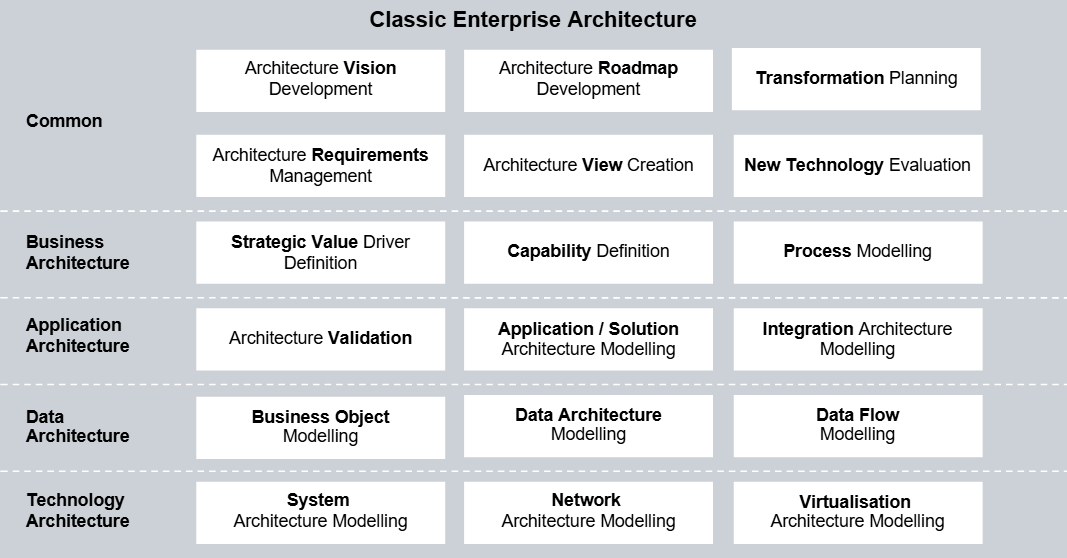
Figure 2: The Classic PwC Enterprise Architecture Capability Model
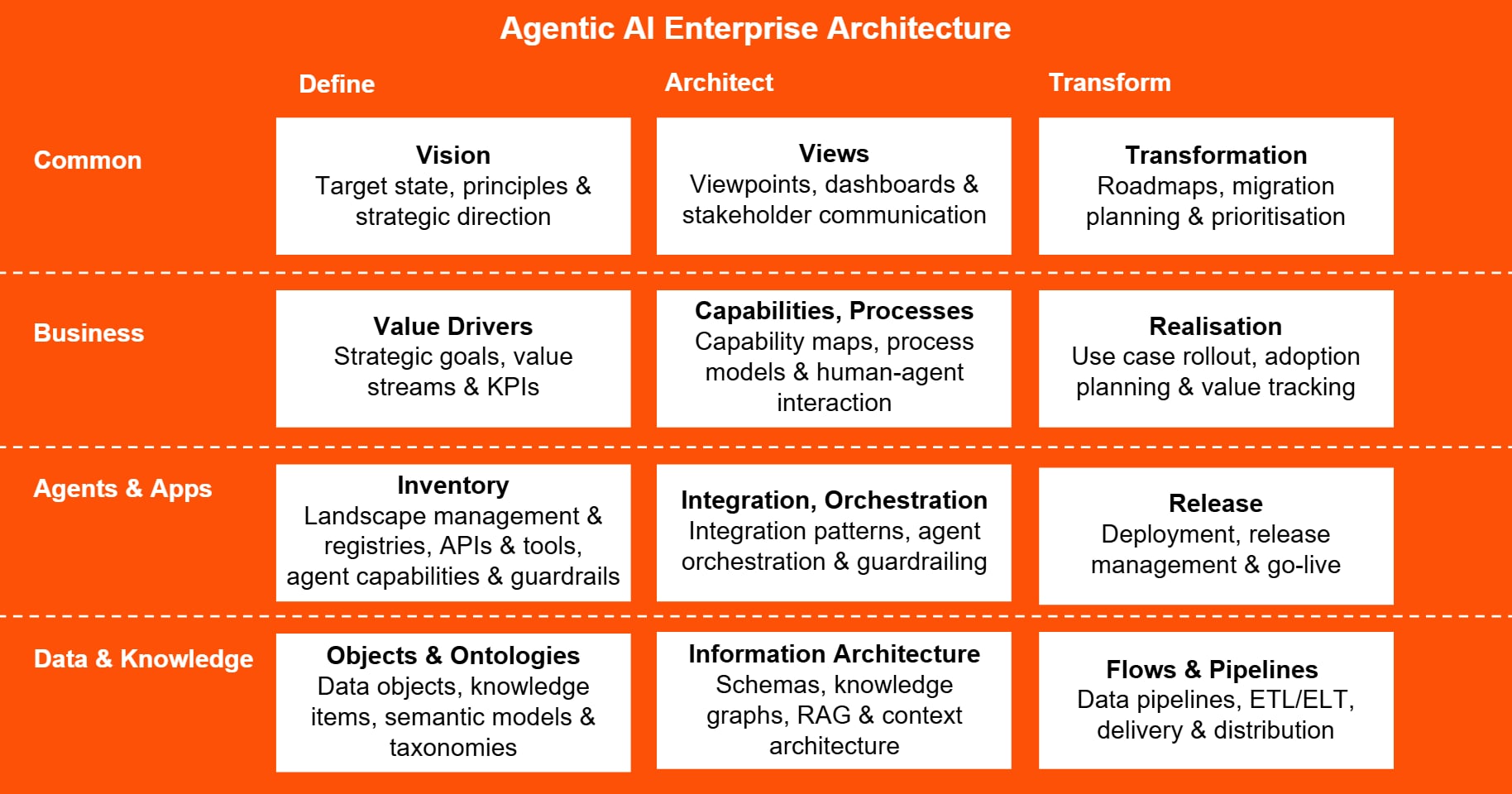
Figure 3: The PwC Agentic Enterprise Architecture Capability Model for architecture development: Business architecture gains importance, Applications merge with Agents, Data extends into Knowledge, and Technology is absorbed into platform choices and the remaining domains. The result: leaner - from 5 domains to 4, from 18 to 12 strategic capabilities.
We're eager to share our vision for the future of enterprise architecture and welcome your thoughts on it.
- Business Architecture remains at the forefront
- Will Agents replace Applications?
- Data gets extended with knowledge
- Technology becomes embedded
- Enterprise Architecture Management, Repository and Governance
Business Architecture remains at the forefront
In today's world of agentic AI, the Business Architecture field is as crucial as ever - perhaps even more so. Agents require a clear business purpose to operate effectively. They need value drivers to grasp priorities, capability definitions to understand organisational potential, and process models to see how tasks flow and where they fit in.
The real shift isn't just about defining who or what delivers—be it a human, a system, an agent, or a hybrid. It's about business architecture becoming a direct input for agents.
Currently, process models and capability maps are documentation — created by humans, read by humans, used for planning and communication. In an agentic enterprise, agents consume these artefacts to decide what to do. A capability definition becomes a contract. A process model becomes an execution instruction. A business rule becomes a guardrail. This means business architecture must be agent-ready: not just descriptive enough for a human audience, but precise and unambiguous enough for an agent to act on.
In a fully agentic future, agents need metadata: process descriptions, business rules, capability definitions, organisational models, KPIs, policies — these become the instructions agents follow.
Your business architecture IS the prompt.
Examples:
- An agent monitors KPIs and follows a policy protocol when thresholds are breached: first activate specialised agents, then alert employees, then escalate to a manager.
- An agent hierarchy for client onboarding: one agent per step — identity verification, risk profiling, document collection — each consuming business rules and objectives. Orchestrator agents coordinate between them, according to process diagrams.
Will Agents replace Applications?
It's a bold question: Why do we have applications at all when we can interact directly with intelligent, personalised agents? These agents handle every task needed—they just require data, knowledge, and support from other specialized agents.
Consider what today's applications actually are: a user interface, business logic, data access, and integration points — bundled into a package. Now consider what an agent does: it communicates in natural language, reasons about business logic dynamically, accesses data through tools and APIs, and orchestrates across systems natively.
But this is a future direction, not our current reality. Legacy systems will persist for decades. New applications will still be built. And for tasks that need to be done efficiently, at high volume, and consistently—applications might still hold their ground. Yet, the architectural focus is shifting: from applications as the main execution layer to agents as the primary orchestration layer.
That's why we've merged them into one domain: Agents & Applications. Today, agents and applications still differ in how they are built, integrated, and managed. But agents are already calling and embedding applications - and beginning to generate their own application logic. The two may soon be indistinguishable.
Applications and agents are converging
Examples:
- Copilot in M365 or SAP: an agent embedded in the application — it reads data, suggests actions, executes tasks. Where does the application end and the agent begin?
- A CRM application routes a complex customer request to an agent, which reasons about the case, pulls data from multiple systems, and returns a recommendation — all within the application's interface. The user never notices the handoff.
Data gets extended with knowledge
Data has transitioned from a supporting role to taking centre stage. For years, it was merely a component of applications—stored in databases, shaped by application logic, and managed by application teams. Its rise as a distinct architectural domain marks a significant journey: from data warehousing to master data management, and now to data mesh and data products.
Agents are transforming this landscape further: Because they don't just query databases — they consume unstructured information and knowledge to reason, plan, and act. A policy document, an email thread, a process description — these become direct inputs for agent behaviour. It is no longer enough to make knowledge available to humans in documents. We must explicitly manage, curate, and structure it so that agents can read, retrieve, and correctly interpret it — for RAG (Retrieval-Augmented Generation), for context, for autonomous decision-making.
This calls for new architectural concepts:
- Knowledge graphs and ontologies that provide agents with semantic understanding.
- Retrieval augmented generation (RAG) architectures that ground agent responses in organisational knowledge
- Agent memory and context stores that enable agents to maintain state across interactions
- Embeddings and vector databases that make unstructured knowledge searchable
- Metadata — process descriptions, business rules, data lineage — that agents need to operate effectively
This is why we renamed the domain from Data Architecture to Data & Knowledge. It's not just about storing and modelling data anymore. It's about curating the metadata and the knowledge fabric that agents reason on.
Data management becomes knowledge curation
Examples:
- An agent answering a compliance question retrieves and cross-references internal policies, regulatory documents and past audit reports - none of which sit in a traditional database.
- A customer-facing agent maintains context across interactions - remembering previous requests, preferences and open issues - through an agent memory store.
Technology becomes embedded
This is less about Agentic AI and more about trends that have been building for years: cloud, virtualisation, everything-as-a-service, zero trust.
When infrastructure is consumed as a service — the architectural significance of modelling systems, networks, and virtualisation separately diminishes. With zero trust, even the network perimeter loses its relevance — security is no longer a function of topology, but of identity and policy.
Here's what this means for you: Technology capabilities — system, network, and virtualisation architecture — are increasingly absorbed into platform choices, cloud configuration, and security policy. They don't vanish, but their strategic importance as a separate architectural domain decreases. Enterprise architecture creates the most strategic value today in the design of business capabilities, agents & applications, and the data & knowledge that powers them.
Consider these examples:
- A development team can now access compute, storage, and networking with a single API call - or choose to go serverless. There's no need for server architecture.
- A company migrates to a cloud platform that bundles infrastructure, security and compliance out of the box — what was once a complex technology architecture decision becomes a configuration choice.
Enterprise Architecture Management, Repository and Governance
A capability model defines what we architect. Yet, an enterprise also requires capabilities for managing Enterprise Architecture, maintaining the Enterprise Architecture repository, and ensuring governance.
While Enterprise Architecture management and the repository remain consistent in an agentic world, governance transforms. When agents act autonomously, new questions arise: Who owns an agent? Who is responsible for its decisions? How do we ensure compliance?
Two critical additions to the governance model:
- Guardrails: These are machine-enforceable boundaries that limit agent behaviour in real-time—a key governance concept.
- Agent & Data Governance: This addresses accountability, ownership, and compliance for autonomous agents and the data they use.
We intentionally leave two questions open: How should governance adapt for autonomous agents? And how will architecture roles evolve? These are topics for another blog post.
Summary: From automation to autonomy
Enterprise Architecture is evolving. In an agentic world:
Business architecture becomes the primary input for agents — your business architecture is the prompt
Applications and agents are merging into a single domain
Data management evolves into knowledge curation
Technology integrates into platform choices
Our Agentic Enterprise Architecture Capability Model reflects these shifts: it’s leaner, with four domains and twelve capabilities - an evolution, not a replacement.
This is our starting point. We're eager to hear yours.
Contact us
Markus Hegi